From Basketball Royalty to Football’s Financial Second Tier
In 1990, the Atlantic Coast Conference was one of the most respected athletic conferences in America. It was the undisputed center of the college basketball universe, home to Duke, North Carolina, NC State, Wake Forest, Maryland, Virginia, Clemson, and Georgia Tech.
Thirty-five years later, the ACC stretches from Boston to California, includes 18 full members, and finds itself battling a growing financial divide between itself and the SEC and Big Ten.
How did we get here?
The answer involves much more than television contracts and conference realignment. It includes questionable expansion choices, missed opportunities to add nationally prominent athletic programs, internal political rivalries, and business decisions whose consequences are still being debated.
It also includes some fascinating what-ifs.
What if the ACC had added Miami alongside Florida State in 1990? What if Virginia Tech hadn’t been included in the 2004 expansion? What if Connecticut had joined instead of Pittsburgh or Louisville?
And perhaps most intriguing: What if Texas and Oklahoma had joined the ACC rather than eventually moving to the SEC?
Some of these possibilities were seriously discussed. Others were rumors, contingency plans, or speculative scenarios. Distinguishing among them is essential to understanding what the ACC’s leadership could realistically have done.
The conference’s history contains undeniable successes. But it also raises a troubling question: Did the ACC’s leadership spend too much time protecting established relationships and preserving the conference’s traditions while the business of college athletics fundamentally changed?
1990–1991: Florida State and the First Great Opportunity
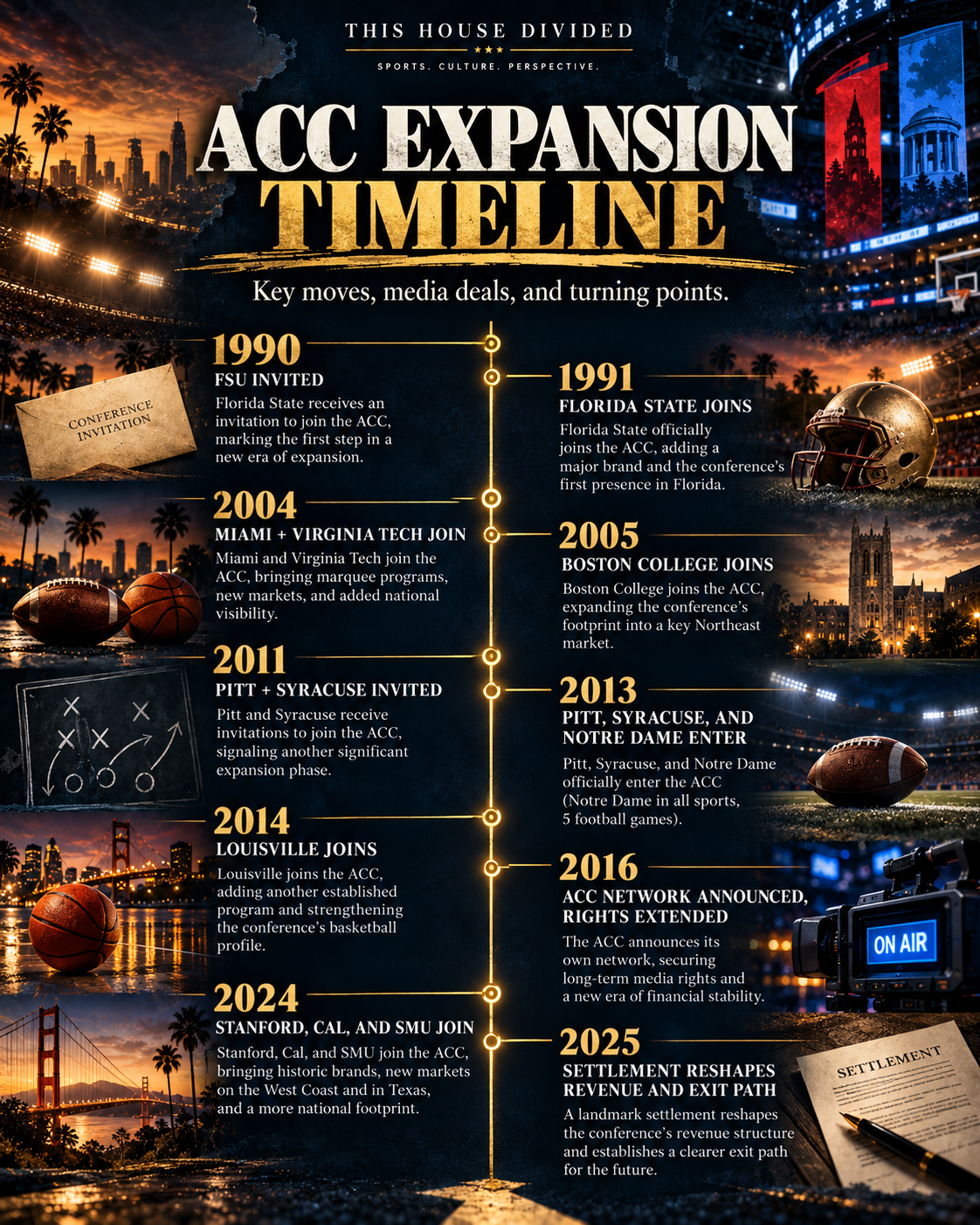
The ACC’s modern expansion history began when Florida State accepted an invitation in 1990 and officially joined in 1991.
At the time, football was not the conference’s strongest selling point. Clemson and Georgia Tech had won national championships during the previous decade, but the ACC was predominantly identified with basketball.
Florida State changed that almost immediately.
Under Bobby Bowden, the Seminoles became a national powerhouse, winning the 1993 and 1999 national championships and establishing a remarkable run of ACC dominance. They added another national title in 2013 under Jimbo Fisher.


It would be difficult to identify a more transformative athletic acquisition in ACC history.
But the conference may have missed an opportunity to accomplish something even bigger.
During that same expansion period, Miami was looking for a conference home. The Hurricanes had emerged as college football royalty, and the possibility of bringing both Florida State and Miami into the ACC existed.
Other schools discussed around that period included South Carolina, Virginia Tech, Pittsburgh, Syracuse, West Virginia, Boston College, Rutgers, and Navy.
These weren’t all formal offers or equally serious candidates. Nevertheless, the opportunity to reshape the conference was real.
Instead, the ACC stopped at nine members, while Miami joined the Big East for football.
Imagine the competitive landscape if Florida State and Miami had entered the ACC together in the early 1990s.
Both programs would have been competing for national championships under the ACC banner. Their annual rivalry could have become the centerpiece of conference football, with nationally significant games regularly showcasing the ACC.
The conference might have developed into a much stronger football television property years before the next wave of realignment.
Assessment: Florida State was an A+ addition, but stopping after one school may have been the ACC’s first major strategic mistake.
2003–2005: The Big East Raid—and an Unexpected Winner
The next major expansion was designed to transform the ACC into a football superconference.
Miami was the centerpiece. The Hurricanes had won the 2001 national championship and played for another in 2002.
The ACC’s early expansion configuration involved Miami, Syracuse, and Boston College.
But Virginia politics intervened.
Virginia Tech, originally facing exclusion, became central to securing support for the expansion. Ultimately, Miami and Virginia Tech joined in 2004, followed by Boston College in 2005.
In retrospect, the results were nearly the opposite of what many anticipated.
Virginia Tech: The Surprise Success
Under Frank Beamer, Virginia Tech became one of the ACC’s most successful football programs almost immediately.

The Hokies won ACC football championships in 2004, 2007, 2008, and 2010.
For much of their first decade, they delivered exactly what the ACC wanted: nationally relevant football, competitive championship games, and a passionate fan base.
Virginia Tech also brought natural regional rivalries, particularly with Virginia and future ACC member Pittsburgh.
Its later struggles don’t erase its extraordinary early value.
Grade: A−
Miami: The Great Underachiever
Miami entered the ACC with five national football championships and expectations of continued dominance.
Instead, the Hurricanes went more than two decades without winning an ACC football championship.
Their only appearance in the ACC Championship Game through 2025 came in 2017.
Miami has maintained significant national name recognition, a valuable recruiting territory, and competitive success in other sports, including men’s basketball.
Its renewed football prominence in 2025 and 2026 may eventually change the overall assessment.
Still, the return on the ACC’s marquee 2004 acquisition fell far below expectations for much of its membership.
Grade: B
Boston College: The Weakest Long-Term Return
Boston College’s arrival was initially successful.
The Eagles reached the ACC football championship game in 2007 and 2008, and the Matt Ryan era provided memorable moments.
Boston College has also maintained an exceptional men’s hockey tradition, although hockey isn’t an ACC-sponsored sport.
But sustained success in football and men’s basketball has been elusive.
One of the arguments for adding Boston College involved extending the ACC’s presence into the Boston television market. Yet conference membership does not automatically translate into capturing an entire metropolitan television audience.
Considering its long-term major-sport performance, Boston College may be the ACC’s most disappointing expansion addition.
Grade: C−
The great irony of the 2004 expansion is that the school nearly left out—Virginia Tech—delivered the strongest immediate football results.
2010–2012: Texas, Oklahoma, and the Conference That Might Have Been
This is where ACC expansion history gets especially interesting.
There have been persistent stories that Texas and Oklahoma were interested in joining the ACC before eventually moving to the SEC.
The historical record shows that Texas’s interest was genuine. Oklahoma’s role in a potential ACC move is much less certain.
Texas Was More Than a Rumor
In September 2011, as the Big 12 struggled to maintain its membership, Texas athletic director DeLoss Dodds acknowledged discussions with ACC Commissioner John Swofford.
Speaking to reporters, Dodds said:
“We had good conversations with [commissioner] John Swofford.”
He went on to acknowledge mutual interest if the Big 12 collapsed.
That is a remarkable historical detail.
Texas wasn’t merely a name floated by fans on message boards. Its athletic leadership had discussed ACC membership directly with the commissioner.
The Longhorns were exploring options amid a period when Nebraska had departed for the Big Ten, Colorado had joined the Pac-12, and Texas A&M was preparing to enter the SEC.
Texas preferred to preserve the Big 12 if possible. It also had a significant financial complication: the Longhorn Network.
The university had entered into a lucrative 20-year agreement with ESPN for a dedicated network. Any new conference arrangement would have required accommodating that relationship.
Whether the ACC could have made those economics work remains uncertain.
But this much is clear: The ACC had a genuine opportunity to explore acquiring one of college sports’ most valuable brands.
What About Oklahoma?
Oklahoma’s situation is murkier.
During the 2010–2011 realignment turmoil, Oklahoma explored other conference possibilities, particularly the Pac-12. Texas, Oklahoma, Oklahoma State, and Texas Tech were involved in serious discussions about a western expansion scenario.
Reports and speculation about a broader ACC expansion sometimes connected Texas with other Big 12 programs, and Oklahoma was an obvious potential partner because of its rivalry with Texas.
However, the public evidence does not establish that Oklahoma formally sought ACC membership or received an ACC invitation.
The idea that the ACC rejected a concrete Texas-Oklahoma package therefore goes beyond what the documented record supports.
Nevertheless, the hypothetical is enormous.
Imagine Texas and Oklahoma in the ACC
Consider what the two programs could have delivered.
Texas would have brought one of America’s largest athletic brands, a passionate fan base, access to the Texas recruiting market, and considerable television appeal.
Oklahoma would have added one of college football’s most successful historical programs, substantial national recognition, and its annual rivalry with Texas.
Pair those schools with Florida State, Clemson, Miami, and Virginia Tech, and the ACC could have possessed a football inventory capable of competing with virtually any conference.
Games such as Texas–Florida State, Oklahoma–Clemson, Miami–Oklahoma, and Texas–Virginia Tech would have created compelling national television matchups.
The annual Texas–Oklahoma rivalry could have become an ACC showcase.
There would have been obstacles, of course.
Geography, television rights, Oklahoma State’s position, Texas’s desire for control over its media properties, and the economics of sharing conference revenue all would have complicated any deal.
And it would be wrong to assume that the ACC could simply have invited both universities and received immediate acceptance.
Still, the possibility deserves a prominent place in ACC history.
In 2021, Texas and Oklahoma formally pursued SEC membership. Both schools ultimately joined the SEC in 2024.
The ACC didn’t merely miss out on two football programs. It missed the chance—however difficult to achieve—to change its position in the national college sports hierarchy.
2011–2014: Connecticut, Pittsburgh, Syracuse, and Louisville
While Texas was exploring its options, the ACC was actively building its northeastern presence.
Pittsburgh and Syracuse accepted invitations in 2011 and entered in 2013.
But another major basketball program was available: Connecticut.
UConn had just won the 2011 men’s national championship and was already established as an extraordinary force in women’s basketball.
Why didn’t the ACC add Connecticut?
One factor was opposition from Boston College.
Then-BC athletic director Gene DeFilippo acknowledged that Boston College opposed Connecticut’s admission, partly because it wanted to protect its position as the conference’s New England football representative.
Personal and institutional rivalries were also involved following Boston College’s departure from the Big East.
That raises an uncomfortable question: Why should an existing member’s desire to protect its own market have outweighed the conference’s opportunity to add a nationally accomplished basketball program?
Pittsburgh has been a respectable addition and won the ACC football championship in 2021.
Syracuse delivered major early basketball value but has struggled to sustain national success in football and men’s basketball.
Meanwhile, Connecticut won men’s national championships in 2014, 2023, and 2024, along with continued women’s basketball dominance.
Those accomplishments wouldn’t necessarily have occurred exactly as they did had UConn joined the ACC.
But the university’s long-term basketball potential was unmistakable.
The Second Connecticut Opportunity
When Maryland announced its departure for the Big Ten in 2012, the ACC had another opening.
Louisville and Connecticut emerged as important alternatives.
The ACC selected Louisville.
At the time, it was a defensible decision.
Louisville offered an established football program, a major basketball tradition, and successful baseball and other athletic programs.
Lamar Jackson later became a Heisman Trophy winner in an ACC uniform.
Louisville’s 2013 men’s basketball championship came before its ACC membership and was subsequently vacated, so it cannot reasonably count as an ACC accomplishment.
Viewed across multiple sports, Louisville has still delivered substantial value.

But in basketball, Connecticut’s achievements make the comparison painful.
Perhaps the biggest mistake wasn’t choosing Louisville over Connecticut.
Perhaps it was failing to find room for both.
Assessment: Louisville earns a B, Pittsburgh a B−, and Syracuse a C. Connecticut remains arguably the ACC’s greatest documented basketball-related missed opportunity.
The West Virginia and Cincinnati What-Ifs
Connecticut wasn’t the only school that could have strengthened the ACC.
West Virginia would have been an interesting geographic and cultural fit.
The Mountaineers have passionate football supporters, substantial football history, and natural rivalries with Pittsburgh and Virginia Tech.
Adding West Virginia could have strengthened the conference’s Mid-Atlantic identity and provided attractive annual football matchups.
Cincinnati also deserves consideration, particularly as an alternative discussed during the 2012 expansion period.
The Bearcats later demonstrated their football potential by reaching the College Football Playoff following the 2021 season.
Neither school was guaranteed to become a national powerhouse in the ACC. Nevertheless, both offered potential football value and geographic connections that some later additions lacked.
South Carolina presents another historic what-if.
The Gamecocks were ACC charter members before leaving in 1971. By the early 1990s, South Carolina had joined the SEC.
Had the ACC somehow retained or regained South Carolina, the conference would have preserved another major southeastern football rivalry and a natural geographic fit.
These scenarios are less about missed formal invitations than about the different conference that might have emerged from a more regionally focused expansion strategy.
John Swofford, Raycom, and the Television Decisions That Changed Everything
Conference expansion is only part of the ACC’s story.
Arguably, the more consequential decisions involved television rights.
Former ACC Commissioner John Swofford served from 1997 through 2021, overseeing much of the conference’s growth and the creation of the ACC Network.
His tenure deserves credit for several achievements, including negotiating conference stability, expanding national exposure, and securing Notre Dame’s partial membership.
But Swofford’s media arrangements—particularly the ACC’s continued relationship with Raycom Sports—have attracted substantial criticism.
The 2010 ESPN Deal
In 2010, the ACC negotiated a 12-year television rights agreement with ESPN reportedly worth approximately $1.86 billion.
The agreement consolidated the conference’s football and basketball rights and significantly increased its television revenue.
But it also continued an important arrangement with Raycom Sports, the longtime regional broadcaster of ACC athletics.
ESPN sublicensed a package of conference programming and associated rights to Raycom in an arrangement reportedly valued at $50 million annually.
Raycom’s survival was closely connected to maintaining its ACC relationship.
A contemporary Sports Business Journal investigation reported that approximately 80 percent of Raycom Sports’ annual revenue came from ACC-related business.
The article also documented Swofford’s desire that ESPN structure a deal preserving Raycom’s participation.
That preference has since become one of the central controversies surrounding the commissioner’s legacy.
The Family Connection
Swofford’s son, Chad Swofford, worked for Raycom Sports.
According to information later cited in Florida State’s legal complaint, Chad was involved in business development at Raycom in 2008 and subsequently held senior positions, including a leadership role in ACC Digital.
In January 2024, Florida State amended its lawsuit against the ACC to raise allegations concerning John Swofford’s handling of the Raycom relationship.
The university contended that the arrangements had disadvantaged conference members financially and alleged that Swofford’s family connection contributed to decisions favoring Raycom.
The complaint characterized aspects of the arrangement as self-dealing.
Florida State also advanced an estimate of $82 million annually in lost value associated with certain media rights.
That figure was a litigant’s allegation, not an independently established annual loss.
Nor was it judicially established that Swofford violated a legal duty, improperly benefited his son, or intentionally harmed the conference.
Raycom had worked with the ACC for decades before John Swofford became commissioner. The broadcaster possessed genuine production, distribution, marketing, and sponsorship capabilities.
There were legitimate business reasons for continuing the relationship.
But that does not eliminate the governance question.
When a conference commissioner negotiates a major commercial arrangement involving a company employing his son, what safeguards should exist to protect the conference and its members?
Even when a transaction has legitimate business explanations, the appearance of a conflict of interest can damage confidence in leadership.
Did the ACC Leave Money on the Table?
This is the more important financial question.
By 2010, the SEC had already positioned itself as a premier football television property.
The ACC, despite its basketball prestige and growing football inventory, followed a different path.
Critics argue that maintaining Raycom’s role constrained the conference’s ability to maximize the value of its secondary and regional media rights.
Supporters counter that the agreement increased revenue substantially, improved exposure, and preserved a valuable broadcasting partner.
A definitive financial judgment would require comparing the actual contract terms with credible alternative offers available at the time.
The mere existence of Raycom’s sublicense does not prove that the ACC could have obtained the entire sublicensing amount as additional revenue.
Nevertheless, the historical record establishes that Raycom’s inclusion was an important negotiating priority.
Whether preserving that relationship served the conference’s financial interests better than a different arrangement is a legitimate question.
And in hindsight, the ACC’s widening television revenue gap makes that question especially consequential.
2016: The ACC Network Arrives—But at What Cost?
In July 2016, the ACC and ESPN announced a new long-term agreement that would launch a dedicated ACC Network in August 2019.
The agreement extended the conference’s ESPN media rights arrangement through the 2035–2036 academic year.
It also extended the conference’s grant of rights, strengthening the ACC’s control over member schools’ media rights.
At the time, those provisions were celebrated as tools for stability.
The ACC finally had its own national network, and its members appeared contractually committed for two more decades.
Yet the television business changed.
The SEC and Big Ten continued negotiating lucrative media arrangements, and the value of premium college football inventory grew enormously.
The ACC faced a difficult reality: Its members were committed to a long-term television structure while rival conferences benefited from different contracts and renewal opportunities.
The very arrangements designed to preserve the ACC’s stability began to feel restrictive to some of its most valuable football members.
Florida State and Clemson became increasingly vocal about the widening revenue gap.
Both ultimately pursued legal action against the conference.
This does not mean that the 2016 agreement was irrational. A dedicated network required significant investment and long-term cooperation with ESPN.
The ACC obtained genuine benefits, including wider distribution and a more predictable revenue stream.
But the trade-off was substantial.
The ACC purchased long-term stability at the cost of limiting its ability to capitalize on future increases in the value of college football television rights.
Whether a shorter agreement or more flexible financial terms were attainable remains open to debate.
Notre Dame: The ACC’s Most Unusual Membership Arrangement
Any evaluation of ACC expansion must also examine Notre Dame.
The Fighting Irish joined the ACC in most sports in 2013 while retaining football independence.
Under the arrangement, Notre Dame agreed to play five ACC football opponents annually on a rotating basis.
The conference gained an internationally recognized athletic brand, strong basketball programs, excellent Olympic sports, and regular football scheduling opportunities.
For Notre Dame, the benefits were equally clear: a stable conference home for non-football sports without sacrificing its football independence.
The arrangement has been beneficial, but it raises a recurring strategic question.
Would the ACC be dramatically more valuable if Notre Dame participated fully in football?
Almost certainly.
A full football membership would add another premium national brand to the conference’s regular-season inventory and championship structure.
But the important caveat is that Notre Dame’s independence was central to the agreement. There is no basis for assuming that the ACC could have simply demanded full football membership and secured it.
The more realistic comparison is between partial Notre Dame membership and having no Notre Dame affiliation at all.
By that standard, the agreement was a success.
Grade: B+ for the arrangement the ACC actually obtained.
2024: The ACC Goes Coast to Coast
The collapse of the Pac-12 presented another unusual opportunity.
The ACC responded by adding Stanford, California, and SMU.
Stanford and California brought academic prestige, major research universities, and extraordinary athletic traditions outside football and men’s basketball.
SMU brought access to the Dallas market, substantial donor resources, and an ambitious football program.
In its first ACC football season in 2024, SMU went undefeated in conference regular-season play and reached the ACC Championship Game.
That was an exceptional debut and made SMU one of the conference’s most promising recent acquisitions.
Stanford and California have contributed valuable Olympic-sport programs, although their football and men’s basketball impact has been less convincing.
But this expansion raises a different question.
Does membership growth actually improve a conference if it simultaneously increases operating expenses and undermines geographic coherence?
Cross-country travel imposes costs on athletic departments and additional demands on student-athletes.
Traditional rivalries become harder to maintain.
And the conference’s identity becomes increasingly difficult to define.
The financial structure of the expansion was unusual, with Stanford and Cal agreeing to reduced distributions for an initial period and SMU foregoing its standard ACC media-revenue distribution for nine years.
That made the arrangement more financially attractive for existing members.
But the long-term calculation remains uncertain.
SMU looks like an early football success. Stanford adds enormous non-revenue athletic prestige. California’s major-sport contribution is less obvious.
The verdict on the 2024 expansion remains to be seen.
2025: The Lawsuit Settlement That Changed the Rules
The disputes involving Florida State, Clemson, and the ACC were resolved in March 2025.
The parties agreed to dismiss their pending litigation and adopt a revised financial framework.
The settlement introduced a larger revenue-distribution component based on football and men’s basketball television viewership.
That was a significant departure from the conference’s traditional approach of dividing much of its media revenue equally.
The settlement also clarified a pathway for schools to leave the conference.
Exit fees would decline over time, reaching approximately $75 million in the 2030–2031 academic year, while departing schools could retain their future media rights after satisfying the agreed terms.
ESPN had also exercised its option in January 2025 to continue its base media-rights relationship with the ACC through 2035–2036.
Together, these developments reflected two competing priorities: preserving the league while acknowledging that its most commercially valuable programs wanted greater financial flexibility.
The 2025 settlement should not be interpreted as a court finding validating Florida State’s earlier accusations about Swofford or Raycom.
But it demonstrated that the ACC’s longstanding business model had reached a point where significant changes were necessary to maintain internal agreement.
Which Expansion Schools Actually Helped the ACC?
The chart below and accompanying table make the evaluations easier to scan.
Judging conference additions requires separating reputation from performance.
A university can bring a valuable national brand without delivering championships. Another can produce excellent football teams without significantly improving media revenue.
And success in men’s basketball, women’s basketball, baseball, soccer, lacrosse, or other sports contributes to a conference even when football dominates the financial discussion.
Here is a retrospective assessment of the ACC’s additions since 1990.
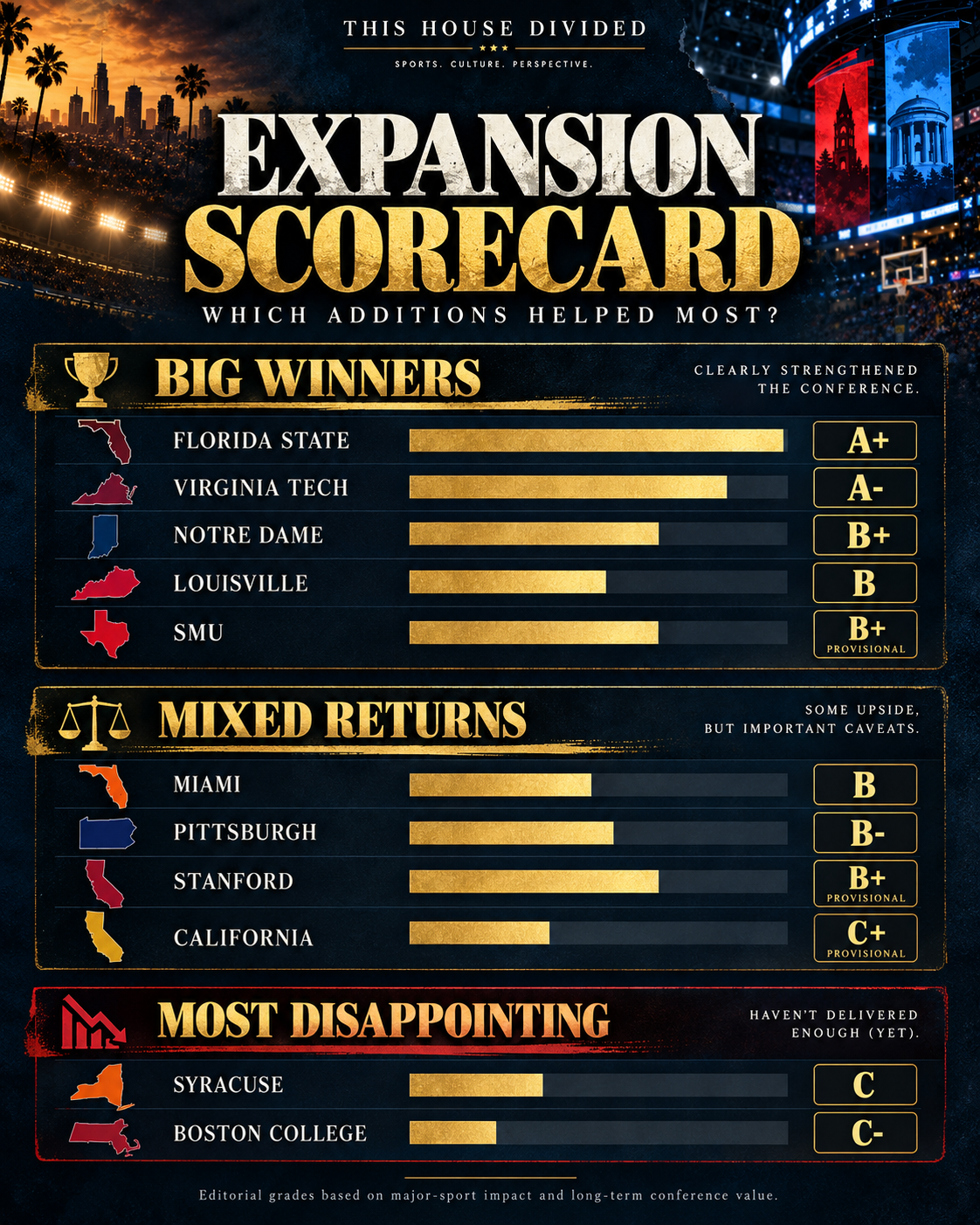
| School | Overall grade | Assessment |
|---|---|---|
| Florida State | A+ | Transformative football acquisition, multiple national championships, national television appeal |
| Virginia Tech | A− | Four early ACC football titles, strong regional rivalries, outstanding initial value |
| Notre Dame | B+ | Exceptional national brand and non-football athletic value, limited by football independence |
| Miami | B | Valuable brand and strong athletic tradition, but football significantly underachieved for much of its ACC tenure |
| Louisville | B | Good football value, basketball pedigree, strong baseball tradition |
| Pittsburgh | B− | Respectable football performance, 2021 ACC title, inconsistent basketball |
| SMU | B+ (provisional) | Extraordinary opening football season, attractive new market |
| Stanford | B+ (all-sports, provisional) | Outstanding Olympic sports, uncertain major-sport and travel economics |
| Syracuse | C | Early basketball value, disappointing sustained football and recent basketball results |
| California | C+ (provisional) | Strong Olympic sports, limited initial football and basketball return |
| Boston College | C− | Early football success, strong hockey outside the ACC, weak sustained major-sport performance |
These grades are editorial judgments, not statistical calculations.
Florida State and Virginia Tech stand out as particularly successful football additions.
Boston College has arguably been the weakest sustained major-sport investment.
Miami represents the greatest difference between original expectations and subsequent football results, although its more recent resurgence deserves recognition.
And it is far too early to issue permanent judgments on SMU, Stanford, or California.
The Greatest Missed Opportunities
Looking backward, several opportunities stand apart.
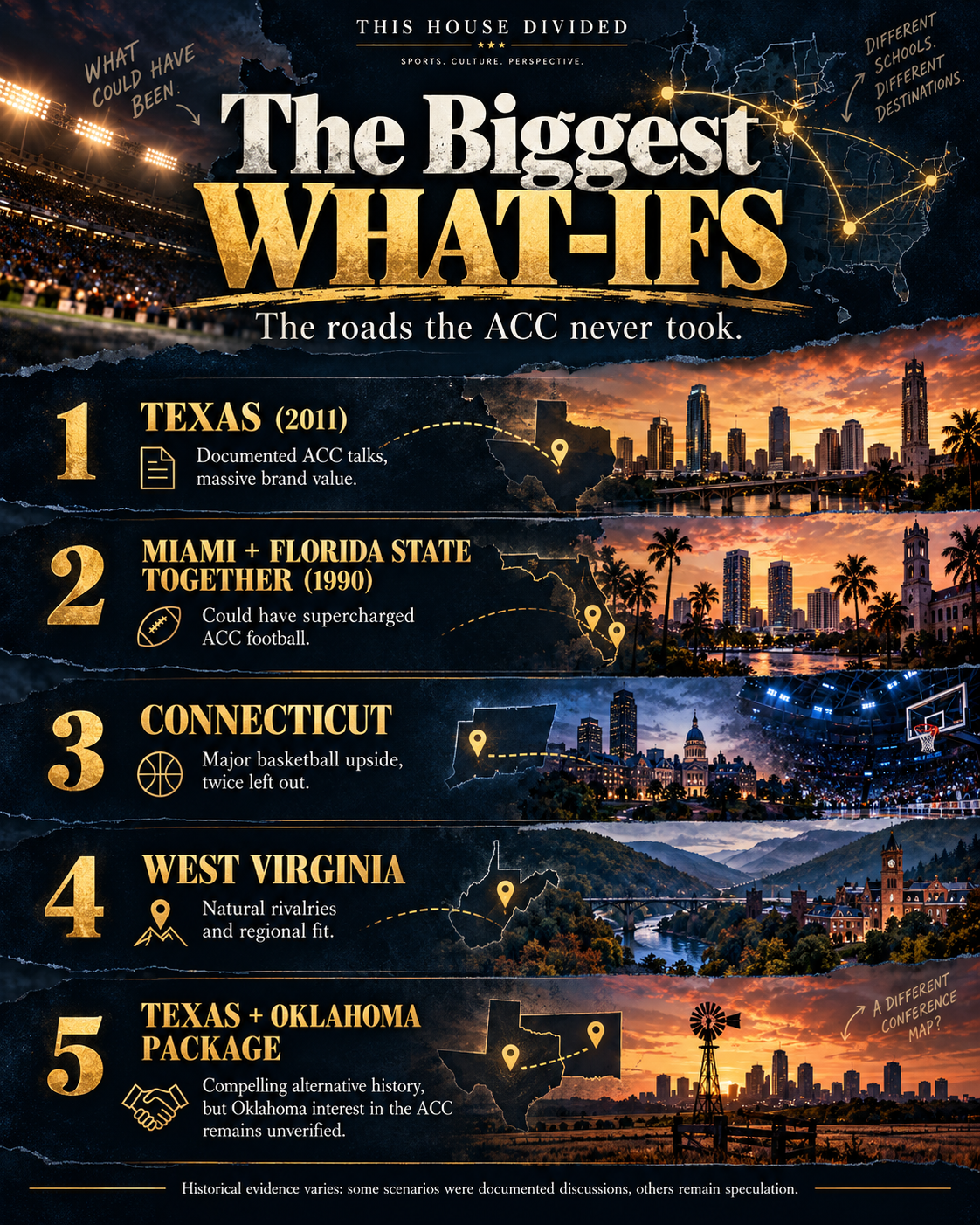
1. Texas in 2011. Unlike many expansion rumors, Texas’s genuine discussions with John Swofford are documented. Securing Texas would have fundamentally changed the ACC’s national television profile.
2. Miami in 1990. Pairing Miami with Florida State at the beginning of the 1990s could have established the ACC as a premier football conference much earlier.
3. Connecticut in 2011 or 2012. UConn would have strengthened the conference’s basketball identity and northeastern rivalries, although its football value was more limited.
4. West Virginia. The Mountaineers offered passionate football support and natural rivalries that would have reinforced the ACC’s eastern identity.
5. Cincinnati. Its later football success suggests an intriguing opportunity to add another competitive program with regional connections.
6. A Texas-Oklahoma package. This is the biggest hypothetical scenario, but the evidence for Oklahoma as a genuine ACC candidate is much weaker than the evidence for Texas.
There is also a different kind of lost opportunity: Maryland.
The Terrapins were a founding ACC member and an important part of its basketball culture, rivalries, and geographic identity.
Their departure for the Big Ten in 2014 demonstrated that conference membership and longstanding tradition were no longer sufficient to keep institutions together.
Retaining an established member with deep ACC roots might have been as important as finding another school to add.
Three Strategic Mistakes That May Have Defined the ACC’s Future
Looking across the entire period, three broader themes emerge.
1. The ACC Reacted Instead of Leading
Adding Florida State was a forward-looking move.
But too often afterward, the conference expanded in response to instability elsewhere rather than pursuing a coherent long-term vision.
The 2004 expansion responded to football economics and changing conference alignments.
The 2011 expansion responded to Big East and Big 12 instability.
Louisville replaced Maryland.
The 2024 western expansion responded to the collapse of the Pac-12.
Each decision had individual merits, but the collective result was a conference shaped as much by external events as by its own strategic priorities.
2. The ACC Underestimated Football’s Financial Dominance
For decades, ACC basketball was the conference’s crown jewel.
Duke, North Carolina, NC State, Wake Forest, Maryland, and Virginia produced nationally significant basketball programs and some of America’s most compelling rivalries.
That prestige remains important.
But football ultimately became the central economic engine of major college conference athletics.
The SEC recognized and capitalized on that shift. The Big Ten leveraged its football inventory and enormous institutional footprint into increasingly valuable media arrangements.
The ACC added Florida State, Miami, Clemson’s existing program, and Virginia Tech to its football product, but failed to turn those assets into equivalent sustained financial power.
The Texas opportunity illustrates what might have been possible with a more aggressive strategy.
3. The Conference’s Business Relationships Deserve Scrutiny
The Swofford-Raycom controversy is not proof of wrongdoing.
It is, however, an important case study in conference governance.
Sports Business Journal documented the commissioner’s desire to retain Raycom as a partner. Florida State later alleged that the resulting arrangements harmed member institutions and questioned the influence of Swofford’s family connection.
Those are separate facts, and they should not be conflated.
But conference commissioners owe their primary professional loyalty to the institutions they represent.
As college athletics became a multibillion-dollar media business, decisions involving television rights, long-term contracts, sublicensing, and potential conflicts of interest deserved the same level of scrutiny expected in other major commercial enterprises.
Whether the ACC’s negotiating strategy maximized member value is a question that deserves serious historical examination.
What Would the Ideal ACC Have Looked Like?
Consider an alternative version of conference history.
Florida State and Miami join in the early 1990s.
Virginia Tech eventually comes aboard, along with Pittsburgh and West Virginia.
The league secures Connecticut to reinforce its basketball dominance and adds Louisville as another competitive football and basketball program.
Then, during the 2011 Big 12 turmoil, the ACC finds a workable structure to add Texas—and perhaps Oklahoma if a genuine joint opportunity can be created.
The resulting conference would feature extraordinary football brands alongside the traditional basketball powers.
Florida State, Miami, Clemson, Texas, Oklahoma, and Virginia Tech would form a formidable football foundation.
Duke, North Carolina, Virginia, Connecticut, and other established programs would maintain tremendous basketball credibility.
Its geographic reach would still be broad, but concentrated in the eastern and south-central United States instead of spanning the continent.
Would that conference have surpassed the SEC financially?
Not necessarily.
Would Texas and Oklahoma have accepted the arrangement?
We don’t know.
Could the existing ACC members have agreed on revenue distribution and television rights?
That’s another major uncertainty.
But the scenario illustrates the opportunity cost of decisions made over several decades.
Conferences are shaped not only by the schools they admit, but also by the institutions they fail to secure and the financial arrangements that determine whether those members can remain competitive.
The Verdict: Expansion Wasn’t the ACC’s Biggest Problem
It is tempting to blame the ACC’s difficulties on schools such as Boston College, Syracuse, or California.
But that may miss the larger point.
Those schools didn’t negotiate the conference’s television contracts. They didn’t determine its long-term media strategy or decide whether the ACC should pursue Texas.
And they didn’t independently control how conference revenues were distributed.
Those decisions were made by conference leadership and the member institutions governing it.
John Swofford deserves credit for guiding the ACC through decades of upheaval. His tenure included major expansion, Notre Dame’s arrival, and the creation of the ACC Network.
But a complete assessment of his legacy must also consider the long-term economic consequences of his media agreements, the Raycom relationship, and the conference’s position relative to the SEC and Big Ten.
Similarly, ACC presidents and chancellors deserve scrutiny. Conference commissioners do not make these major decisions in isolation.
The member institutions participated in approving expansion, rights agreements, and governance structures.
The ACC’s present competitive and financial challenges cannot be attributed to one commissioner, one contract, or one school.
They represent the cumulative consequences of decisions made over more than three decades.
And perhaps the most telling example is Texas.
In 2011, the Longhorns had direct conversations with the ACC about a potential future together.
Thirteen years later, Texas and Oklahoma entered the SEC.
Meanwhile, the ACC expanded all the way to California.
That contrast captures much of the conference’s modern history.
The ACC became bigger. But did it become as strong as it could have been?
That is the question its leaders—and its fans—will continue debating for years to come.
Sources and Further Reading
The following reporting and official documents provide the factual foundation for this analysis. The hypothetical conference scenarios and assessments are editorial interpretations.
- ACC Official Membership History — Atlantic Coast Conference.
- Texas Athletic Director DeLoss Dodds Discusses ACC Conversations, September 2011 — The Dallas Morning News.
- Texas in the ACC? September 2011 Realignment Reporting — The Key Play.
- Texas and Other Big 12 Schools in Pac-12 Discussions — Sports Business Journal.
- ACC’s 2010 ESPN Television Agreement — Atlantic Coast Conference.
- History With ACC Secures Future for Raycom — Sports Business Journal, October 2010.
- Florida State’s Lawsuit Allegations Involving Swofford and Raycom — Associated Press, January 2024.
- ACC and ESPN Announce the ACC Network and Rights Extension — ESPN, July 2016.
- ACC and ESPN Renew Long-Term Agreement — ESPN, January 2025.
- ACC, Clemson and Florida State Settle Litigation — Atlantic Coast Conference, March 2025.
- Clemson’s Statement on the Settlement and Revised Exit Fees — Clemson University, March 2025.
- Boston College’s Opposition to Connecticut’s ACC Admission — NBC Sports, October 2011.
- Texas and Oklahoma’s Formal SEC Membership Requests — Big 12 Conference, July 2021.
- ACC Expansion to Stanford, California, and SMU — Associated Press, September 2023.
Editorial note: This article combines documented history, reported allegations, and hypothetical scenarios. Rumored or speculative opportunities are identified as such. The assessments and conclusions represent opinion rather than official ACC findings.